Lesson 1
Introduction to Electronics
In this lesson, you will learn the basic language of electronics:
Introduction
Everything around us uses electricity in some way. From a simple LED to a smartphone, computer, robot, and electric vehicle, electricity is an important part of modern technology.
Electronics is the field of science and technology that deals with controlling the flow of electricity using electronic components.
What are electrons?
What is electricity?
What is electric current?
What is voltage?
What is resistance?
What is electrical power?
How are these concepts related?
You don't need to memorize everything at once. These concepts will become clearer as we build circuits in the following lessons.
In this lesson, we will learn some basic ideas that will help us understand electronics:
What Are Electrons?
Everything around us is made up of matter.
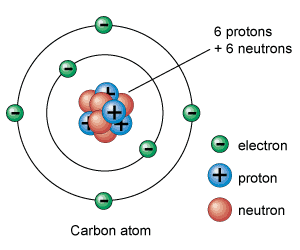
Matter is made up of extremely tiny particles called atoms.
An atom contains:
Protons — positively charged
Neutrons — have no electrical charge
Electrons — negatively charged
What Is Electricity?
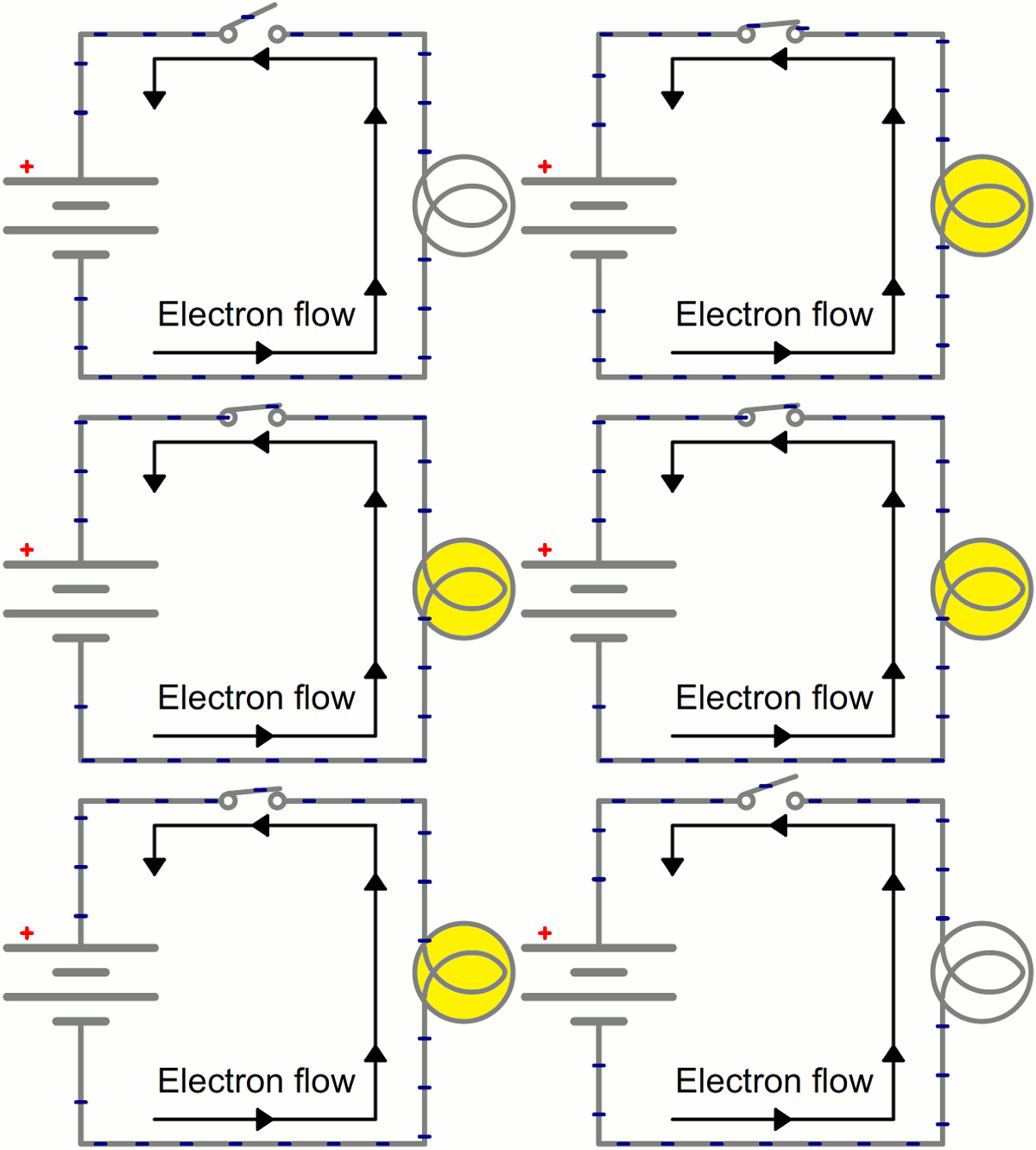
Electricity is associated with the presence and movement of electric charges.
In simple electronic circuits, we are mainly interested in the movement of electrons through materials such as copper wires.
For example, when we connect a battery to an LED using wires, electrons can move through the circuit.
Conductors and Insulators
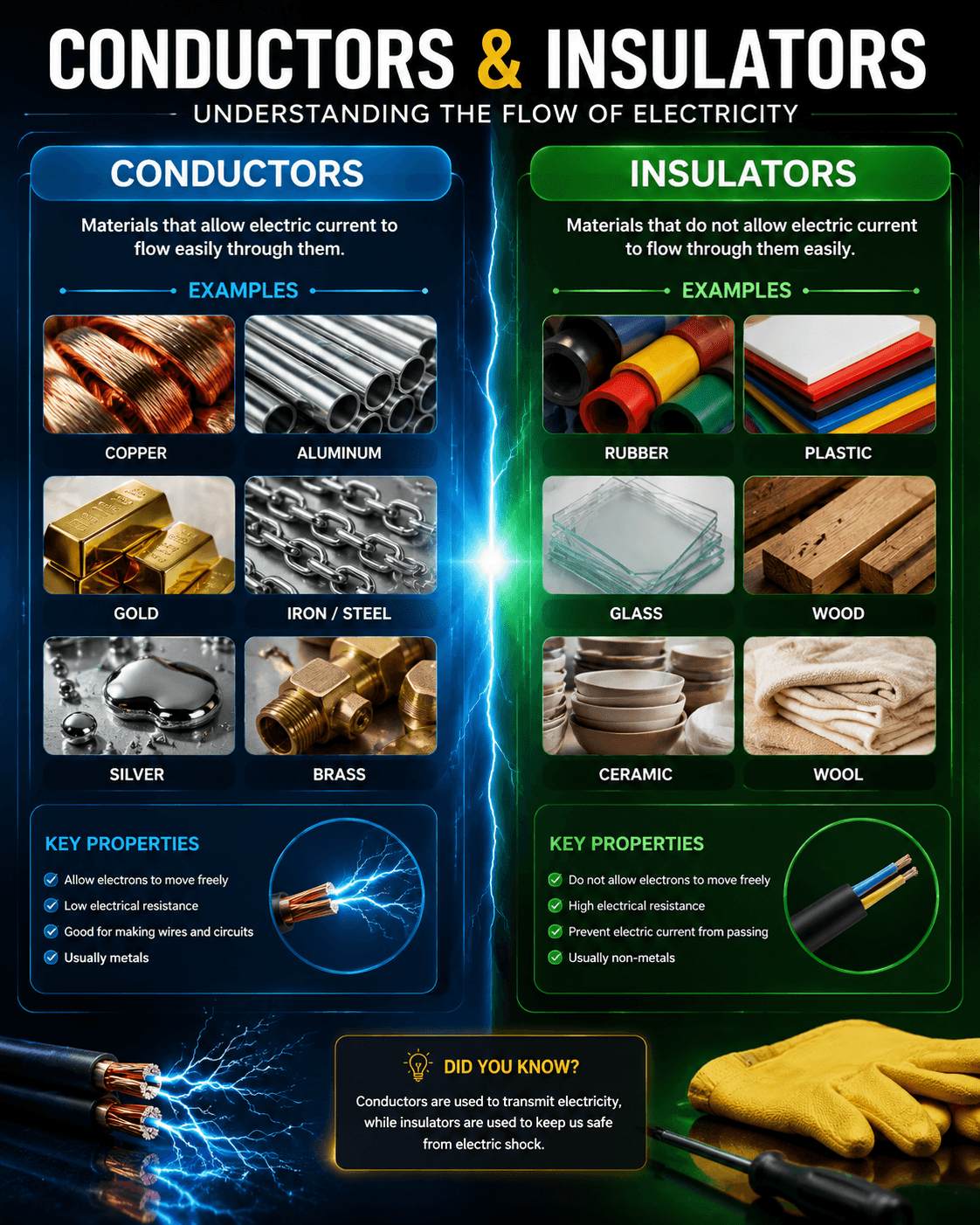
Not all materials allow electric charges to move easily.
Conductors
Conductors allow electric current to flow easily.
Examples:
Copper
Aluminium
Silver
Gold
Copper is commonly used for electrical wires because it conducts electricity well.
Insulators
Insulators do not allow electric current to flow easily.
Examples:
Plastic
Rubber
Glass
Dry wood
This is why electrical wires are usually made with a metal conductor inside and plastic insulation outside.
What Is Electric Current?
Electric current is the flow of electric charge through a circuit.
In metal wires, the moving charge is mainly carried by electrons.
We use the letter:
"I" to represent current.
The unit of current is: Ampere (A)
Small electronic circuits often use much smaller currents, such as:
milliampere (mA)
microampere (µA)
Example
An LED circuit might use approximately:
10–20 mA of current.
A larger electrical device may require several amperes.
Direction of Current
There are two directions that are useful to understand.
Conventional current
By convention, current is considered to flow:
Positive → Negative
Electron flow
Electrons actually move:
Negative → Positive
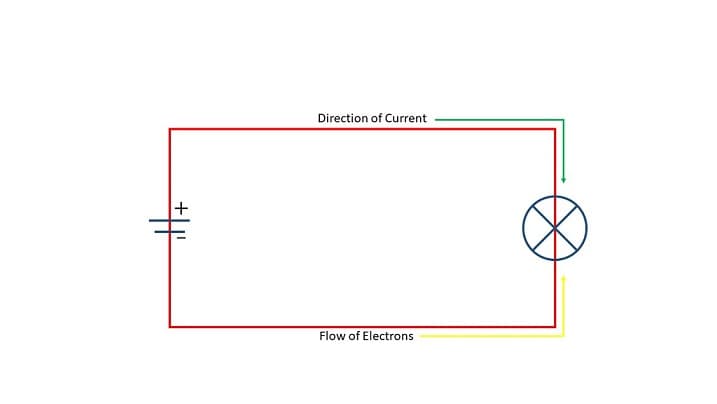
For most beginner circuit diagrams, we use conventional current direction.
You don't need to worry too much about this difference for now. Just remember that both conventions describe the same electrical circuit.
What Is Voltage?
Voltage is one of the most important concepts in electronics.
Voltage is the electrical potential difference between two points.
In simple words:
Voltage is the push that helps electric charge move through a circuit.
Voltage is measured in:
Volts (V)
The symbol for voltage is:
V
Simple analogy
Imagine water flowing through a pipe.
Water pressure → similar to voltage
Water flow → similar to current
Pipe restriction → similar to resistance
More pressure can cause more water to flow if the pipe allows it.
Similarly, voltage provides the electrical potential that can drive current through a circuit.
What Is Resistance?
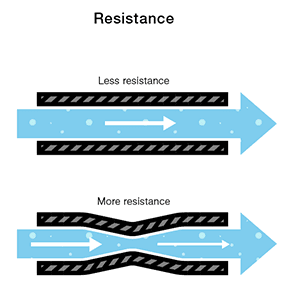
Resistance is the opposition to the flow of electric current.
Resistance is measured in: Ohms (Ω)
The symbol for resistance is: R
A resistor is an electronic component designed to provide a specific amount of resistance.
For example:
220 Ω
1 kΩ
10 kΩ
A higher resistance generally makes it harder for current to flow.
A lower resistance generally allows more current to flow, assuming the voltage and other circuit conditions remain the same.
What Is Electrical Power?
Electrical power tells us how quickly electrical energy is being transferred or used.
Power is measured in: Watts (W)
The symbol for power is: P
A device that uses more electrical power generally transfers or consumes electrical energy at a higher rate.
The basic relationship between power, voltage, and current is:
P = V × I
where:
P = Power in watts
V = Voltage in volts
I = Current in amperes
How Voltage, Current and Resistance Are Related
These three concepts are closely connected.
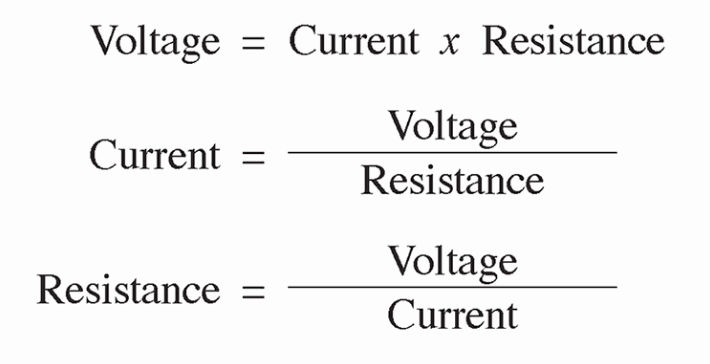
A very important relationship in electronics is Ohm's Law:
V = I × R
Where:
V = Voltage
I = Current
R = Resistance
From this equation:
I = V / R
and:
R = V / I
You will use these relationships frequently when designing and understanding circuits.